

In-house legal teams are not short on expertise. What they are increasingly short on is operational clarity.
As workloads grow and business expectations become more demanding, legal teams are being asked to respond faster, work more efficiently and demonstrate value more clearly. At the same time, pressure to adopt AI is increasing, but the real opportunity is not in adding yet another tool. It lies in reducing the friction around the work itself.
The problem is not just volume
When legal teams say they are overwhelmed, the issue is often framed in terms of volume: more contracts, more requests, more deadlines, more follow-up. But volume is only part of the problem.
A significant amount of legal time is lost in the space around the work — between emails, documents, manual coordination and the constant need to piece together context from different places. According to the 2024 In-House Legal Technology Report,, 70% of respondents spend more than an hour a day switching between systems simply to gain a full view of their work and set priorities.
This matters because legal teams are no longer assessed solely on legal quality. They are also expected to operate with responsiveness, predictability and stronger alignment with the business. When legal work is scattered across disconnected systems, even strong teams end up operating reactively rather than strategically.
Fragmentation creates friction
n many legal teams, work starts in one place, continues in another, and is tracked somewhere else entirely. A request arrives by email, context sits in a document, status lives in a spreadsheet, and follow-up depends on someone’s memory or availability.
This fragmentation does more than slow work down. It also:
- reduces visibility over what is in progress;
- makes prioritisation harder;
- increases the risk of lost context;
- creates unnecessary manual effort.
The same report shows that 77% of legal professionals believe that time spent on manual day-to-day activities reduces their ability to focus on higher-value work..
That is exactly why more teams are rethinking their legal operations: not just to do more, but to work with more structure and less fragmentation.
Where AI can truly help?
AI can play an important role, but not by replacing legal judgement. Its value lies mainly in supporting operations: helping teams prioritise, accelerate routine tasks, reduce manual effort and make execution more fluid.
For legal teams, the first gains tend to appear in areas such as:
- less administrative work;
- better prioritisation;
- greater visibility over ongoing activity;
- less time lost between systems;
- faster, more organised workflows.
This becomes more effective when AI is integrated into a more structured operation, rather than used as a separate tool.
What makes legal operations more structured?
A more structured legal operation does not depend on a radical transformation. It usually begins by reducing fragmentation and making work easier to follow.
In practice, this includes:
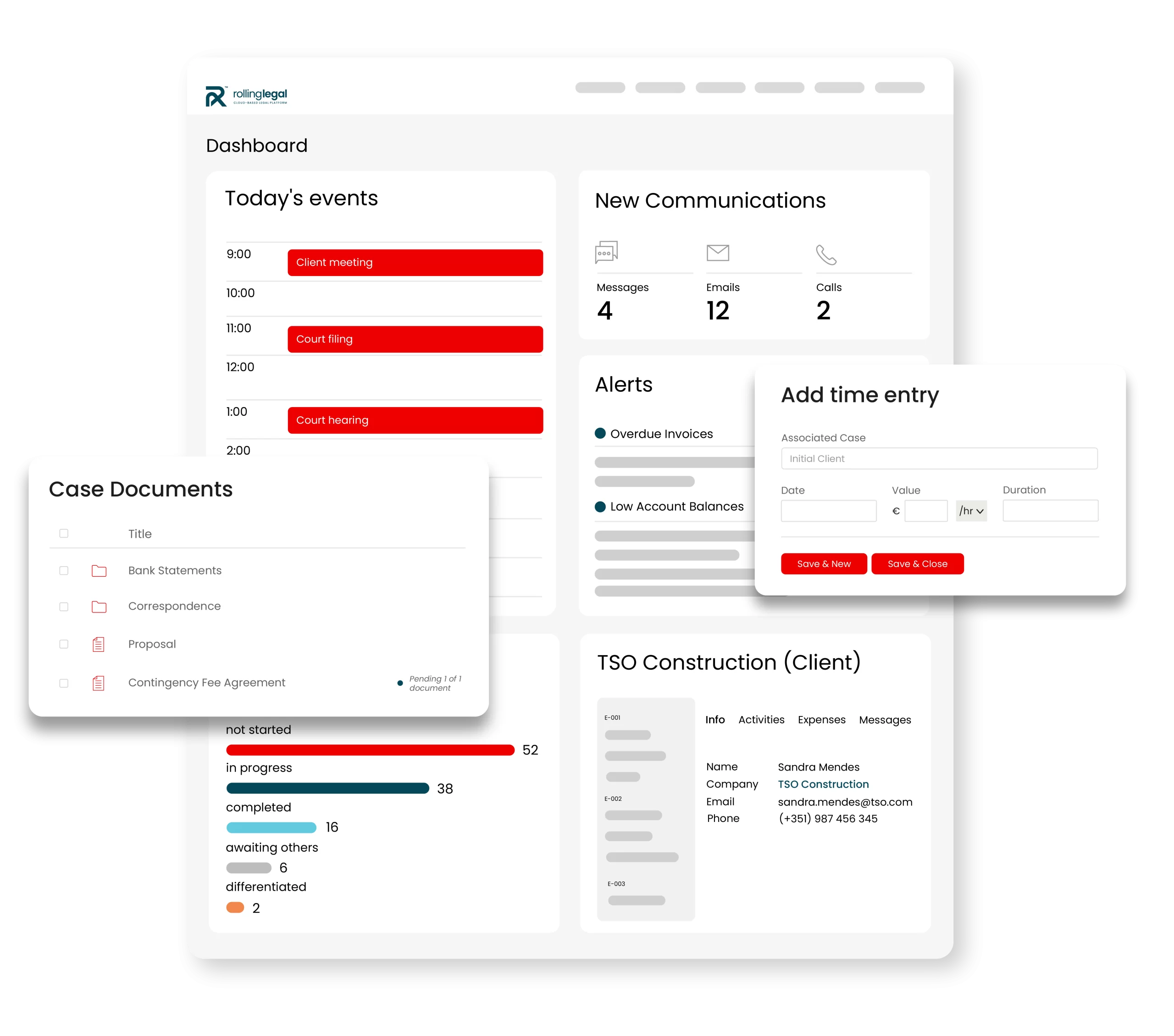
- clearer case management to organise work and simplify workflows;
- chat and email management more closely connected to the right legal activity;
- more structured document management to keep information accessible and contextualised;
- reports and dashboards that make it easier to track indicators, activity and progress more clearly;
- better integrations to reduce fragmentation between tools.
This is the kind of context in which AI becomes more useful: not as an abstract promise, but as practical support for execution.
The real shift for legal teams
If the legal team is constantly busy but still struggles to prioritise, follow up and maintain operational clarity, the problem may not be effort. It may lie in the way work is distributed and connected or disconnected across systems, tasks and information.
More than adding software, what many teams need is a more connected way of managing legal work. One that improves visibility, reduces friction and brings more structure to operations.
That is where the real value of legal technology lies today: not in adding complexity, but in helping in-house legal departments. work with more clarity, greater consistency and less manual effort.
Final takeaway
Productivity in legal teams rarely depends on simply working more. Above all, it depends on reducing the friction that slows good legal work down.
That friction often sits between emails, documents, requests and follow-up. The teams that solve it best are not simply adopting new tools. They are building a more structured operation, with greater visibility, better organisation and the right support from automation and AI.
See how to improve visibility and reduce operational friction.
Not a fan of forms? Send us an email. equipamarketing@rolling-space.pt
 Portuguese
  English
  Spanish