

In today’s legal landscape, innovation has become the watchword. Yet many legal departments and law firms still make the same mistake: assuming that modernisation begins and ends with buying software. The reality is that technology is only a means to an end, never the end itself.
The concept of Legal Operations (Legal Ops) , has transformed the legal sector, but its real success lies in the right balance between people, processes and strategy. When we look at legal excellence and the maximisation of results, we need to go far beyond digital tools.
Is your legal department confusing technological modernisation with operational efficiency?
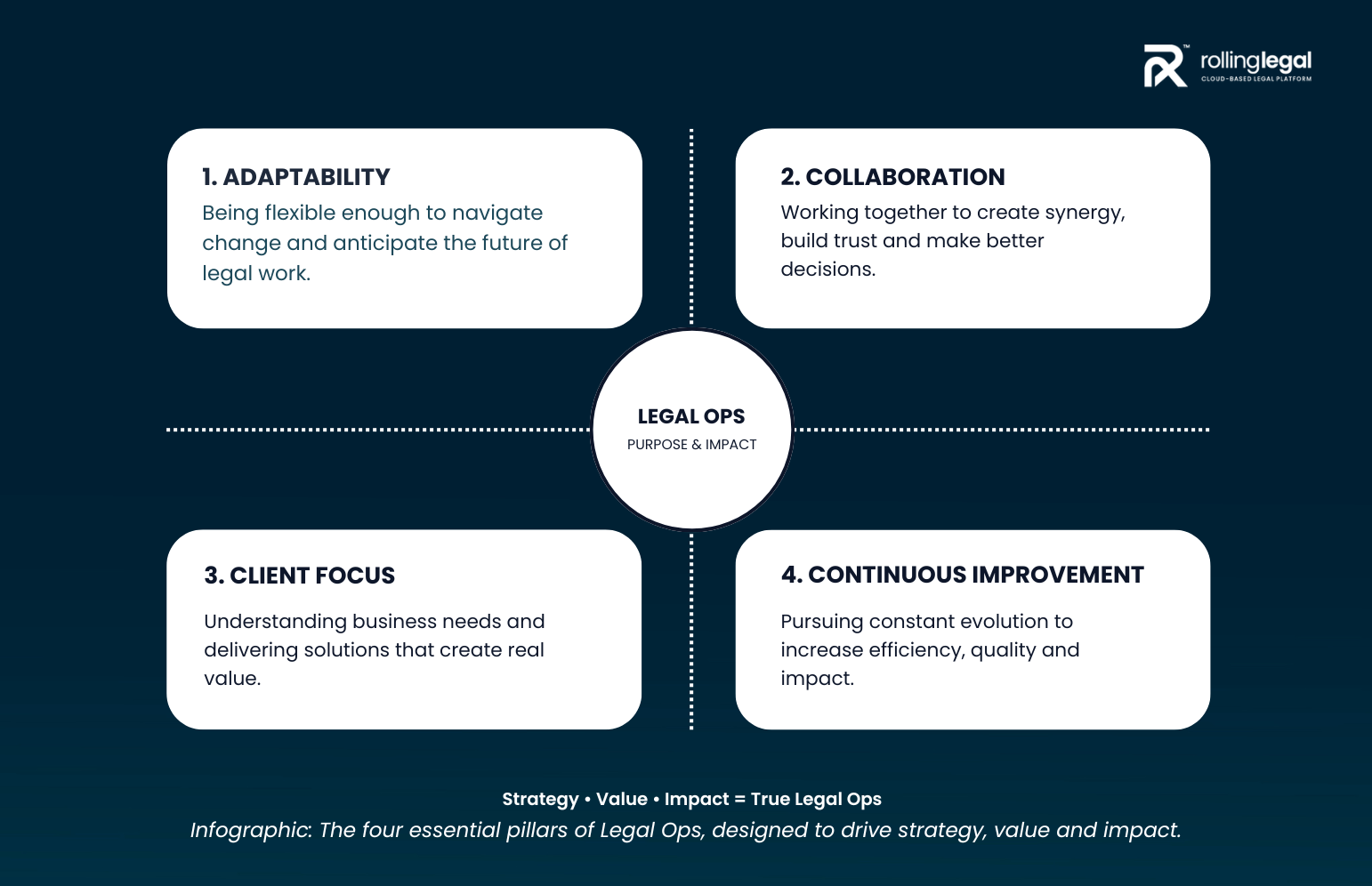
To build a truly robust structure, one that reduces risk, strengthens security, increases strategic relevance and gives Legal greater influence across the business, the Legal Ops ecosystem rests on four fundamental pillars.
1. Adaptability
The legal market and the wider macroeconomic environment are changing at an unprecedented pace. Adaptability means having the flexibility to navigate regulatory shifts, new corporate realities and market crises. More than simply reacting to what happens, a mature Legal Ops team anticipates what is coming next. In doing so,it prepares the organisation and mitigates risks before they materialise.
2. Collaboration
The isolation of lawyers within a “corporate silo” is one of the greatest barriers to growth in any organisation. Collaboration in Legal Ops promotes joint, multidisciplinary work, breaking down barriers between the legal department and other areas such as Finance, Human Resources, Procurement and IT. This synergy creates a strong environment of mutual trust, leading to faster decision-making that is better aligned with business objectives.
3. Client Focus
Who is the client of the legal department? Whether it is the internal client, meaning other business areas within the company, or the end client of a law firm, the premise remains the same: it is essential to understand their real pain points and needs in depth. Client focus changes the perception of the lawyer, moving Legal away from being seen as a “cost centre or bureaucratic blocker” and positioning it instead as a strategic partner that delivers solutions with real value..
4. Continuous Improvement
Excellence is not a static destination; it is a dynamic process. Based on agile management methodologies, the pillar of continuous improvement encourages teams to constantly review existing workflows. The goal is to identify redundancies, eliminate wasted time and optimise operational tasks, ensuring a legal function that becomes more efficient, more predictable and more valuable over time.
Strategy. Value. Impact. That is Legal Ops.
Where should you begin?
By mitigating risks through intelligent processes and empowered people, your team gains greater legal certainty and stronger executive influence to help drive business outcomes.
Se procura elevar o desempenho e a maturidade do seu ecossistema jurídico, lembre-se da regra de ouro: em primeiro lugar, comece pelas pessoas e pela cultura de colaboração, desenhe processos claros com foco na melhoria contínua e trace uma estratégia clara. Só então a tecnologia, como uma plataforma de gestão jurídica integrada, operará a sua verdadeira magia, automatizando, escalando e dando asas a uma fundação que já é inerentemente sólida.
 Portuguese
  English
  Spanish