

“There are days when the ‘final version’ feels like an urban legend.”
A commented PDF. An “almost ready” Word file. An email with “just one more sentence.”
And the question no one wants to ask out loud: which one is the latest version… really?
The problem isn’t having multiple versions. It’s not knowing which one is the final.
Reviewing is normal. Negotiating is normal. Adjusting clauses is normal.
What shouldn’t be normal, yet still happens, is:
- The version sent is not the approved version;
- Changes are scattered across Word files, PDFs, and email bodies;
- The team wastes time confirming the basics: what changed, who approved it, and what stage it’s at.
In the end, the legal team doesn’t just lose time. It loses control, and that takes a toll.
When everything lives in attachments, the process stops existing
In practice, legal work ends up split across three worlds:
- Communication (emails and messages);
- Decision (someone’s “OK” — somewhere).
- Documents (folders, links, attachments);
And when these pieces aren’t connected, contract management turns into a game of hide-and-seek.
The clause is “in the other version,” the opinion is “in yesterday’s email,” and the deadline… well, someone should probably set a reminder.
The scales regain balance
In a controlled environment, the “latest version” isn’t searched for. It’s visible.
And that happens when three things become obvious:
- There is a single active version, with full version history;
- Approvals follow defined stages and responsible parties (no lost “OKs”);
- Documents, tasks, and communication are part of the same process, with full context.
It’s not bureaucracy. It’s clarity. And clarity moves things faster.
It’s about digitizing legal work, not just PDFs.
Moving toward a more digital legal function isn’t about putting everything into neatly labelled folders.
It’s about rethinking the flow:
- Automated approvals;
- Collaborative work, without relying on attachments;
- Full traceability: who decided, when, and why.
Because the future of legal work isn’t in a drawer. It’s where the team can act quickly and with confidence.
Where does Rolling Legal fit in?
With Rolling Legal, work stops living in email and starts living in the process.
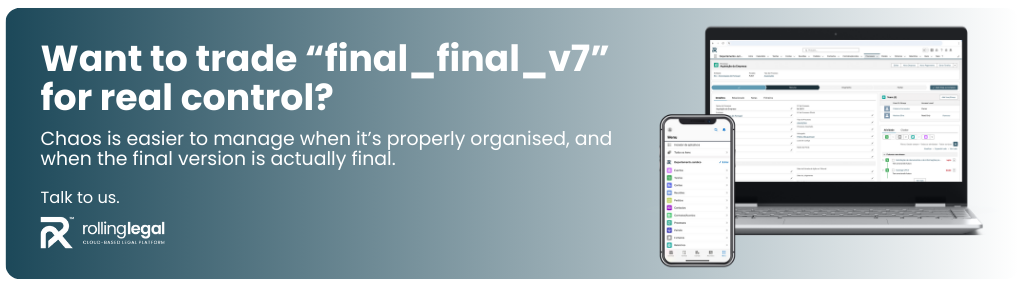
There is a single source of truth with full version history, approval workflows with clear ownership, and documents, tasks, and communication organized in the same space, so the team can work with control, consistency, and speed.
 Portuguese
  English
  Spanish